Every identification on this site is matched against these entries. Each lists the features to look for, the date range each source gives, and how firmly the attribution is established.
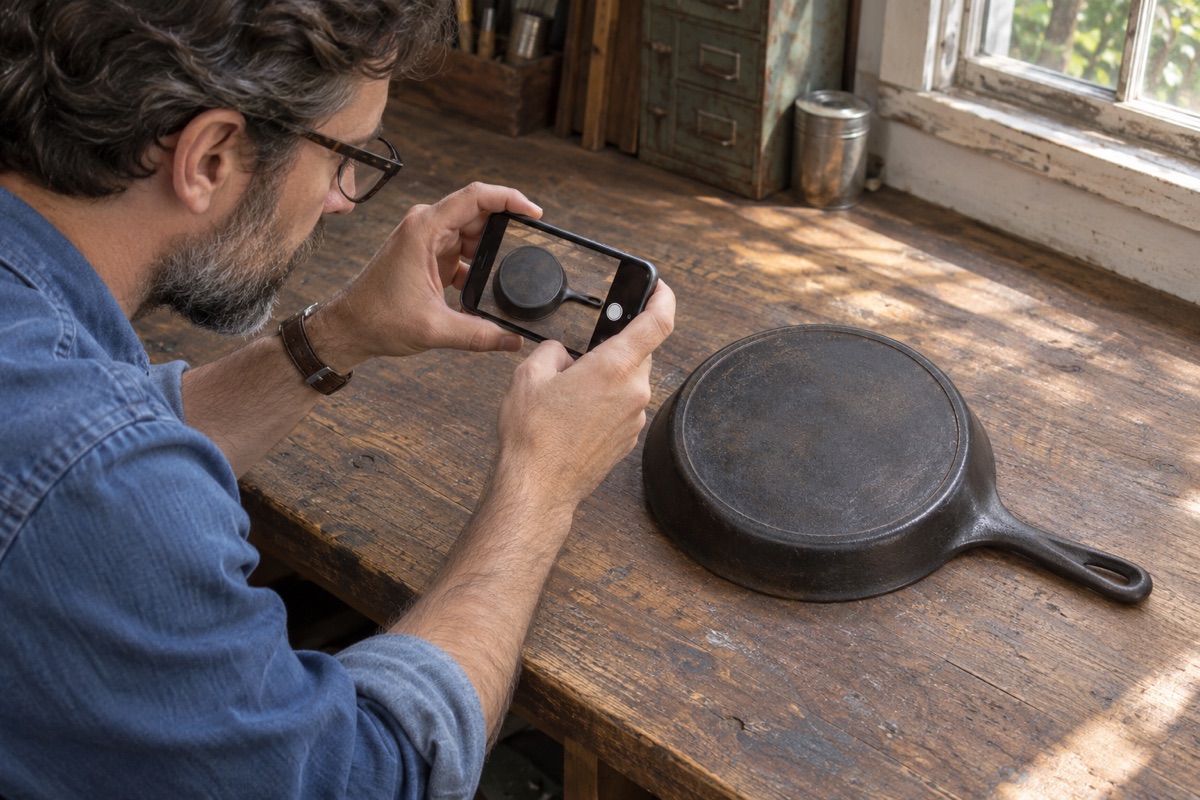
Photographing the base for a closer look. AI-generated illustration.
Diagrams are schematics, drawn bottom up with the handle at 6 o'clock. They show where the ring, notches and size number sit, not the look of any logo.
Lettering of the maker name: upright block letters
Logo size compared with the base: small: a modest mark
Raised ring on the base: none: smooth, flat base
A smaller, lighter logo without CAST IRON SKILLET. Smooth bottom, except sizes 12 and up, which kept a heat ring. Handles changed twice in this period (early, late, and late grooved).
Easily confused: The large block logo is bolder and fills more of the base.
Raised ring on the base: ring set in from the edge
Where the size number sits: on the base at 12 o'clock
Style of the size number: italic, raised
Underside of the handle: hanging hole is an untapered oval
No maker name. Inset heat ring, italic numerals, a half-inch size number at 12 o'clock and a four-digit part number at 6. The handle has an untapered oval opening (except on size 5).
Raised ring on the base: ring set in from the edge or none: smooth, flat base
One large fancy W serves both words, with SIDNEY and -O- beneath. Found at 12 o'clock, or centered on heat-ring skillets in sizes 4–8 (roughly 1924–1935), or high on smooth bottoms with a catalog number.
Easily confused: After 1959 the same logo appears without SIDNEY -O-.
Logo shape: logo inside a wedge (pie slice) border
Raised ring on the base: none: smooth, flat base
The stylized logo inside a wedge-shaped border, with a raised catalog number and pattern letter and CAST IRON SKILLET curving at 6 o'clock. Associated with smooth bottoms.
Style of the size number: cut into the iron (incised)
No maker name. The size number is incised on top of the handle; early examples may carry only that mark. Later ones add a size in words at 6 o'clock, such as 6½ INCH SKILLET, and MADE IN USA from the mid-1960s.
Raised ring on the base: ring right at the outer edge
Where the size number sits: on top of the handle
Outside heat ring, raised size number on top of the handle and a raised molder's letter at 6 o'clock. No marked Blacklock skillet is known, so this attribution is conjecture.
Raised ring on the base: ring set in from the edge
Shape of the ring: has one or more gaps (notches)
Gaps in the ring: one gap, at 12 o'clock
Where the size number sits: on top of the handle or on the base at 12 o'clock
No maker name. Inset heat ring with one notch at 12 o'clock; raised size number on the handle or a one-inch number at 12; small raised molder's letter at 6.
Raised ring on the base: ring set in from the edge
Shape of the ring: has one or more gaps (notches)
Gaps in the ring: three gaps, at 9, 12 and 3 o'clock
Where the size number sits: on the base at 12 o'clock
No maker name. Inset heat ring with notches at 9, 12 and 3 o'clock and a three-quarter-inch size number at 12. Letters such as SK appear from the late 1950s, and MADE IN USA at the center from about the mid-1960s.
Easily confused: Other makers copied the three notches. Collectors have ruled out Lodge on three-notch pans whose handle, small pour spouts and reinforced rim point to automated molding, so compare the handle with a documented Lodge before settling.
Raised ring on the base: ring set in from the edge
Shape of the ring: unbroken
Gaps in the ring: no gaps
Where the size number sits: on the base at 6 o'clock
Style of the size number: underlined or upright, raised
Pour spouts: large
Underside of the handle: ridge runs to the side wall without flattening
No maker name. Unbroken inset heat ring, a three-quarter-inch size number at 6 o'clock that is often underlined, large pour spouts, and a handle ridge that does not flatten at the side wall.
Raised ring on the base: ring set in from the edge
Shape of the ring: unbroken
Gaps in the ring: no gaps
Where the size number sits: on the base at 6 o'clock
Pour spouts: small
Underside of the handle: ridge runs to the side wall without flattening
No maker name. Like Red Mountain but with smaller pour spouts. Late examples show a small size number above the diameter in inches at 6 o'clock, and MADE IN USA at 12 from about 1967.
Gate mark (a raised line or scar across the base): yes
A gate mark on the bottom usually indicates an older piece cast before side gating. For many of these the honest answer is that the maker will never be known; handle design and molder's marks sometimes narrow the region.